
Technical Articles
Cardan Shaft Vibration Causes on Mining Screens: Phasing, Operating Angles and Cross Wear
A vibrating screen driven through a Universal Joint Coupling starts shaking in a rhythm that follows speed, and the cardan shaft is the first suspect. Sometimes rightly: wrong yoke phasing, unequal operating angles and worn cross bearings all cause speed-related vibration. But a screen is a vibration machine by design, and plenty of shafts get replaced for problems that came from the exciter, the springs or the steelwork. This is the diagnostic order we suggest before ordering parts.
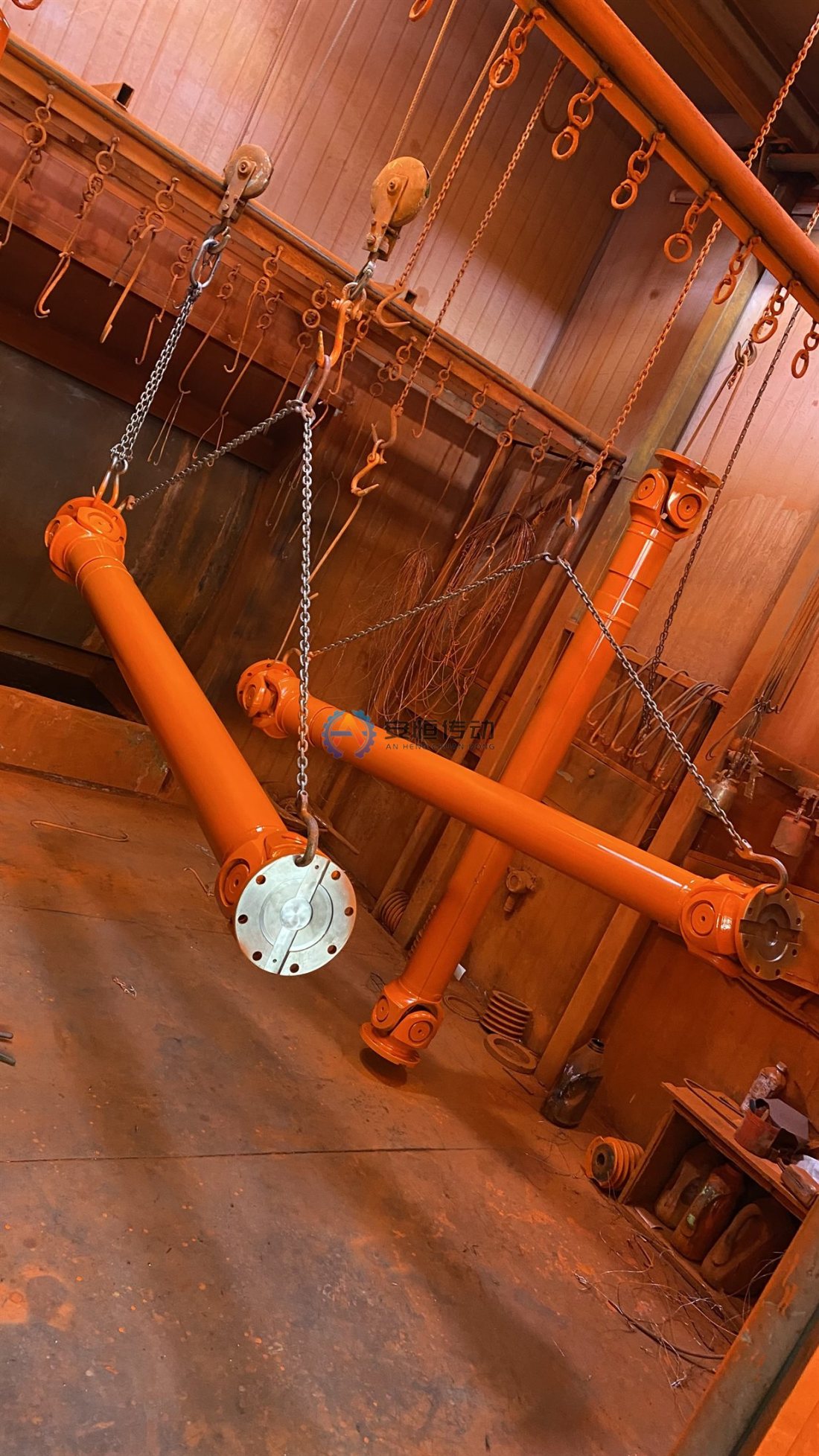
Cardan shaft vibration causes: confirm it is the shaft first
Tie the vibration to a speed before anything else. Measure on the motor and exciter bearings, not only on the screen box, and compare the dominant frequency with cardan shaft speed. On a directly driven exciter the screen's working stroke runs at shaft speed, so a once-per-revolution peak on its own proves very little. The table gives a starting point.
| What you see | Where to look first |
|---|---|
| Strong component twice per shaft revolution, worse at larger angles | Yoke phasing or unequal operating angles |
| Component once per revolution that grows with speed | Imbalance, bent tube, flange runout |
| Knocks at start-up, shutdown or load changes | Worn cross bearings, spline backlash, loose flange bolts |
| Heavy swings while the screen passes through resonance at start or stop | Normal transient, unless the spline runs out of travel |
| Vibration that stays with the shaft uncoupled and the motor running alone | Motor, base frame or neighbouring equipment |
Typical scenario: a screen on a frequency converter runs rough only in one speed band. Before blaming the joints, check whether the base frame or a neighbouring machine resonates there; if the vibration follows the structure rather than the shaft, new joints will not change it.
Check operating angles, yoke phasing and installed position
A single cardan joint at an angle does not transmit uniform speed: the output speeds up and slows down twice per revolution, more so as the angle grows. A two-joint shaft cancels this only when both operating angles are equal and the yokes on the intermediate shaft lie in the same plane. Break either condition and the driven side sees a speed fluctuation that shows up as vibration and extra bearing load.
Measure both angles in the installed position, at rest and, if possible, in operation, because the screen box moves on its springs and the angle at the exciter end moves with it. Confirm the layout is a true Z arrangement (input and output shafts parallel) or W arrangement (shafts inclined symmetrically) with equal angles, and that any compound angle is compensated as the shaft maker intended. Our universal joint working angle checklist covers the measurement in detail.
Then check phasing. Most shafts carry matching marks on the spline sleeve and spline shaft, and after maintenance it is easy to slide them together a few teeth out of position. If the marks are missing, sight along the shaft and compare the two inner yokes before assuming anything worse.
Inspect cross bearings, seals, spline and flange bolts
Lock out the drive, rotate the shaft by hand and have someone watch each joint. Radial or axial play, needle bearings that feel notchy, rust at the seal lips or dust inside the seals all point to a cross assembly near the end of its life. Cross bearings only oscillate through the operating angle, so at very small angles the needles barely roll and the screen's vibration can leave brinelling marks on the races.
Grease each bearing on the manufacturer's schedule until fresh grease shows at all seals, unless the joints are sealed for life. Inspect the slip spline for wear, fretting rust and dry patches; a spline that sticks under torque cannot follow the screen's movement, so it pushes axial load into the joints and exciter bearings.
Finally, check the flange bolts and faces. Loose bolts let a flange shift on its spigot, which looks exactly like imbalance, and fretting marks on the faces show it has already happened. Replace stretched bolts and tighten to the specified torque.
Length, plunge, balance and critical speed
A shaft on a screen must follow the box, so the installed length should leave travel in both directions. If the spline bottoms out while the screen swings through resonance at start or stop, you get a heavy knock; if it pulls too far out, engagement is short and wear accelerates. Compare the installed length with the shaft's compressed and extended lengths before judging the joints.
Imbalance appears mostly once per revolution and rises with speed. A bent tube, a lost balance weight, material caked on the tube or a flange refitted off-centre will all cause it, and a worn spline adds clearance that lets the tube orbit. If the shaft has been repaired, ask whether it was rebalanced as an assembly afterwards.
Long, slender shafts at higher speeds can run near their bending critical speed, where any imbalance is amplified sharply. If vibration climbs steeply over a narrow speed band and falls away above it, suspect critical speed. The cure is usually a shorter shaft, a larger tube or an intermediate support, not new crosses.
Replace the cross assemblies or the whole shaft?
Replace only the cross assemblies when the bearings are worn but the yoke bores are round and undamaged, the spline is within limits and the tube is straight. Replace or rebuild the whole shaft when yoke bores are worn oval, spline backlash is heavy, the tube is bent, or crosses keep failing early, which usually means angle, length or balance was wrong from the start.
For a repair or replacement quote, the more of this you send, the fewer rounds of questions. Please include:
- Overall length: installed, fully compressed and fully extended
- Connection flanges: outside diameter, bolt circle, number and size of bolts, spigot and any face key
- Operating angles at both ends, at rest and in operation
- Speed, motor power and transmitted torque
- Photos of the nameplate, both joints, the spline and any damage
- A description or video of when the vibration appears
Our Universal Joint Coupling line is the SWC series, SWC100 to SWC620 in 14 sizes, with nominal torque Tn from 1.25 to 1000 kN·m across the range. Before we pick a size we check torque, speed, shaft diameter, keyway, service factor, misalignment and the working environment, and if your drive falls outside the range we will tell you rather than force a fit.
FAQ
Will balancing fix twice-per-revolution vibration?
Usually not. That component comes from unequal angles or wrong phasing, which is a geometry problem, and balancing does not change geometry. Correct the angles and phasing first, then balance if a once-per-revolution component remains.
How can I check phasing if the marks are gone?
Sight along the shaft: in a standard Z or W layout, the two yokes on the intermediate shaft should lie in the same plane, unless the shaft maker specified an offset to compensate a compound angle. If they do not, separate the spline, turn it until the yokes line up and mark both parts before refitting.
Why do new crosses wear out so quickly on our screen?
Repeated early failures point to a cause outside the cross: excessive or unequal angles, a sticking spline that drives axial load into the bearings, missed greasing, or dust entering through damaged seals. Replacing crosses without fixing that only resets the clock.
If your screen keeps vibrating and you want a second look at the geometry or a replacement shaft, send us the list above. We can build from your drawing or from photos and measured dimensions of the old shaft, carry out dynamic balancing with a dynamic balancing report on request, and ship standard models in 15–25 days; non-standard lengths are confirmed after we review the drawing. Send us your drawing
Need an engineering selection or replacement review?
Send power, speed, shaft diameters, keyway, installation dimensions, drawings or old-part photos. We will review the working condition before confirming the model and quotation.