Technical Articles
Grid vs Pin Bush Coupling for Conveyors: Guide
Which is better for a conveyor: grid or pin bush coupling?
Neither coupling is universally better. A Grid Coupling is often evaluated when the conveyor has loaded starts, impact or torsional vibration and the maintenance team can service a spring grid and grease-filled cover. A Pin Bush Coupling may be a practical choice for moderate impact, simpler construction and replaceable elastic bushes. The correct comparison starts with the duty and the available maintenance method.
Quick answer: Compare loaded-start torque, shock severity, speed, shaft bores, keyways, allowable misalignment, element replacement, lubrication, guard clearance and overload requirements. Choose the type that controls the actual failure risk and fits the shaft interfaces, not the type with the more familiar name.
1. Compare the conveyor load profile
Record whether the belt starts empty or loaded, the number of starts and stops, incline, material impact, blocked rollers, reversing, braking and the drive inertia. A loaded start or frequent jam creates a different coupling duty from a small, continuously running conveyor. If a jam must trip the drive, define that protection separately rather than expecting either flexible coupling to disconnect automatically.
Use the belt conveyor coupling selection guide for the common input data. The crusher and conveyor grid-versus-gear comparison covers a different product comparison; this article focuses specifically on grid versus pin bush construction for conveyor buyers.
2. Compare torsional cushioning and elastic elements
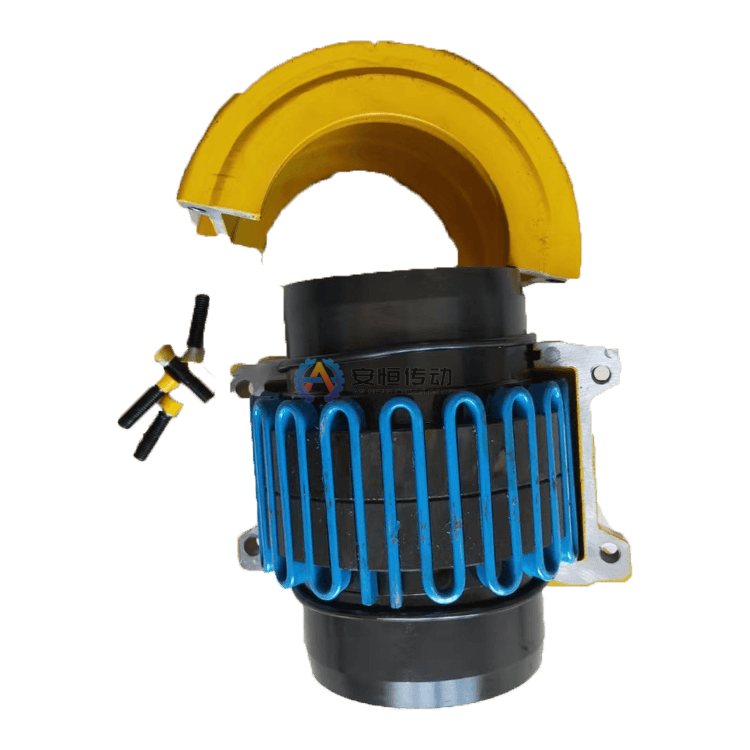
A Grid Coupling uses a serpentine spring grid that deforms in the hub grooves and provides torsional cushioning. A Pin Bush Coupling transmits torque through pins and replaceable elastic bushes. The practical difference is how each element handles startup impact, vibration, wear and replacement. The final choice must use the manufacturer’s rated and peak torque data for the selected size.
Do not infer performance from the number of parts. Check the load cycle, peak torque, operating temperature, element material and failure history. If the conveyor sees severe impact or repeated blocked starts, review whether a Safety Coupling or Torque Limiter Coupling is required as a separate protection device.
3. Check speed, bore and keyway interfaces
Calculate base torque on the coupling shaft using T = 9550P / n, where P is power in kW and n is speed in r/min. Then provide both shaft diameters, bore lengths, keyways, hub lengths, DBSE, outside diameter and overall length. A coupling that meets torque but cannot fit the shaft or guard is not a workable replacement.
For an old conveyor, inspect the shaft shoulder, key flanks and hub bore before copying dimensions. The Pin Bush Coupling product page and Grid Coupling product page provide the product-family context; the selected drawing should control the final bore, keyway and allowable speed.
4. Compare misalignment and installation limits
Both coupling types require alignment within the selected design limits. State angular, radial and axial movement, foundation condition, bearing clearance and expected thermal movement. A flexible element may tolerate a defined offset, but it cannot correct a bent shaft, loose bearing or soft foot. One-sided wear is a reason to inspect the shaft line, not a reason to keep increasing the coupling size.
Check guard clearance, element removal, grease access, bolt access and the direction of disassembly. A grid cover may need service space for spring replacement and grease, while a pin bush arrangement may need access to pins and bushes. The maintenance route should be confirmed before the coupling type is finalized.
5. Compare maintenance and contamination exposure
Grid Couplings typically require attention to grease, seals, cover condition and spring-grid wear. Pin Bush Couplings require inspection of pins, bushes, bolts and the surrounding guard. Dust, water, chemicals and temperature can shorten the life of either element. Record the inspection interval, spare-element availability, shutdown time and the person responsible for the check.
If downtime is the main risk, compare the time and direction required to replace a grid or bush set. If lubrication access is poor, confirm whether the selected design and sealing method can be maintained without removing adjacent equipment. The cheapest element is not always the lowest-cost choice over the maintenance cycle.
6. Decide by failure risk and quotation data
Choose a Grid Coupling when torsional cushioning, shock absorption and a grease-maintained cover fit the conveyor duty. Consider a Pin Bush Coupling when moderate impact, simple construction and replaceable bushes match the equipment and maintenance plan. Consider a Custom Replacement Coupling when the old shaft interfaces, flange or envelope cannot be matched by a catalogue model.
An RFQ should include equipment name, power, coupling-shaft speed, normal and peak torque, loaded-start condition, jam history, shaft bores, keyways, DBSE, guard limits, environment, quantity, old model and photos. Anheng can then compare the two construction types against the actual installation instead of treating the comparison as a price-only decision.
Common comparison mistakes
- Choosing the coupling from conveyor motor power without checking reducer output speed.
- Assuming a flexible coupling is an overload release during a blocked belt.
- Comparing only nominal torque while ignoring start, jam and braking peaks.
- Forgetting element removal space, grease access or spare-part availability.
- Copying worn shaft bores and keyways into the replacement design.
FAQ | Grid vs Pin Bush for Conveyors
Is a grid coupling stronger than a pin bush coupling?
Strength depends on the selected size, element, torque rating, speed, duty cycle and shaft connection. A grid coupling may offer useful torsional cushioning, while a pin bush design may simplify element replacement. Compare the approved data for the actual conveyor duty.
Which coupling is easier to maintain?
That depends on the guard, access and spare-element process. Grid maintenance includes grease, seals and the spring grid; pin bush maintenance includes pins, bushes and fasteners. Evaluate the complete shutdown procedure, not only the number of replacement parts.
Can either coupling protect a conveyor from a jam?
A flexible coupling may cushion impact but should not be assumed to disconnect at a defined torque. If the drive needs controlled slip, disengagement or a stop signal, specify a suitable safety coupling or torque limiter separately.
Need an engineering selection or replacement review?
Send power, speed, shaft diameters, keyway, installation dimensions, drawings or old-part photos. We will review the working condition before confirming the model and quotation.