Technical Articles
Curved Jaw vs Straight Jaw Coupling for Mine Dewatering Pumps: Which One Fits?
Curved jaw and straight jaw couplings look almost identical on a mine pump set, and buyers replacing a dewatering pump coupling often cannot tell which one they have or which one they need. Both work on underground dewatering pumps and on the smaller pumps in a concentrator, but they deal differently with misalignment, with shock from starts and pressure surges, and with wet, muddy conditions. Here is how a curved jaw vs straight jaw coupling compares on these pumps, where each one fits, where neither does, and what to check before swapping one for the other.
How curved and straight jaws differ
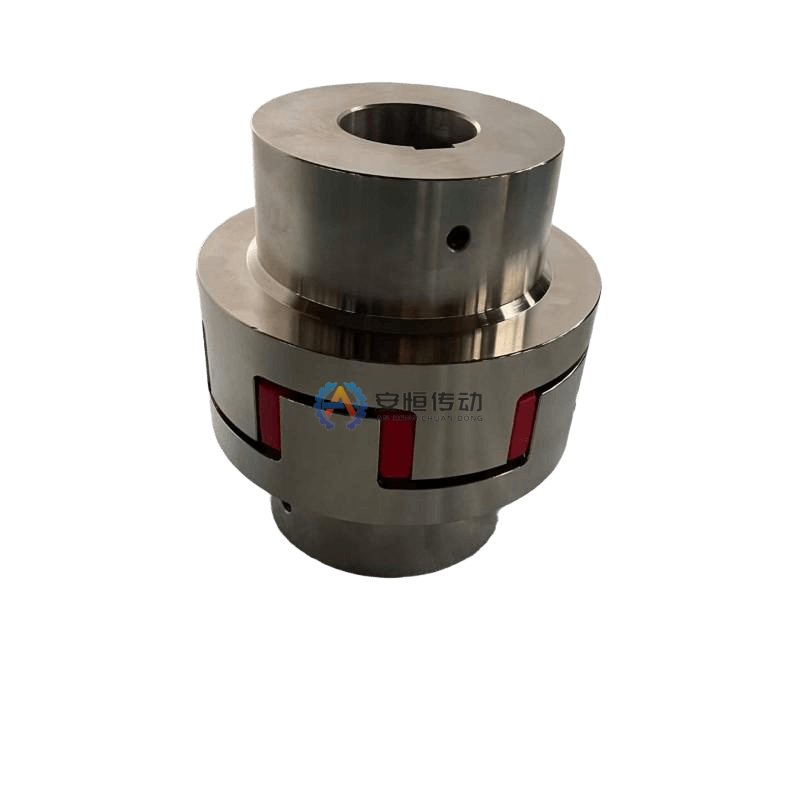
On a Curved Jaw Coupling, the jaw flanks are curved and the star element has crowned teeth that are slightly compressed when the hubs are pushed together. That pre-compression removes play, and the crowned contact keeps load away from the tooth edges when the shafts are at a slight angle, so more of the element surface does the work.
A straight jaw coupling, such as our Jaw Coupling range, has flat jaw flanks and a plum-shaped element that usually sits with little or no pre-compression. It is simple, robust and easy to fit, but under angular misalignment the load moves to the element edges, and when torque reverses there can be a small knock before the jaws pick up the other side.
Both types are fail-safe: if the element is destroyed, the jaws interlock and keep the pump turning, with noise and hub damage as the warning. Neither type tolerates much radial offset, so alignment matters for both; the curved design is simply more tolerant of small angular errors.
What dewatering and concentrator pump duty does to the coupling
Dewatering pumps on level control may start many times a shift, and every direct-on-line start sends a peak torque through the coupling. When a pump stops and the check valve closes hard, the pressure surge can send a short torque spike, sometimes a brief reversal, back through the shaft, and any play in the coupling turns that into knocking that chews the element edges.
This is where the pre-compressed star has an advantage, because there is no play to knock through. Element hardness matters too: our XL curved jaw couplings are rated with a 92 ShA element, and a 98 ShA element carries about 70% more torque, but the harder element also passes shock more directly, so do not switch to it just to gain margin on a shock-loaded pump.
Mine water is wet, often muddy and sometimes chemically aggressive, and pump rooms can be warm. Check the element material against the water, any chemicals and the temperature at the coupling, keep mud out with a solid guard, and stay within the working temperatures: −35 °C to +80 °C for our curved jaw couplings and −30 °C to +80 °C for our straight jaw couplings.
Element changes and spare parts
On the basic versions of both types, changing the element means sliding one hub back, so the motor or the pump has to move unless there is enough axial room. Where a pump set is tightly installed and moving the motor costs a shift, the LMS double-flange jaw coupling lets the element be changed without moving the machines.
Star elements and plum elements are not interchangeable, and elements from different makers often do not fit each other’s hubs even within one type. If a pump station runs a mix, standardize on one type per pump size so that one element type covers all identical pumps, and record the element hardness for each coupling.
Which one to choose
Neither type is better everywhere; the duty and the maintenance situation decide. As a starting point:
| Situation | Better fit |
|---|---|
| Compact pump set, frequent starts, hard check valve closure, no play wanted | Curved jaw (star) coupling |
| Moderate starts, steady duty, plant already stocks plum elements | Straight jaw coupling |
| Motor or pump hard to move for element changes | LMS double-flange jaw coupling |
| Shifting bases, a long gap between shaft ends, or torque beyond both ranges | Neither; a different coupling type |
Typical scenario: an underground pump station runs a row of identical dewatering pumps on level control, and the straight jaw elements wear at the edges and knock at every stop. Curved jaw couplings with a pre-compressed star remove the play there, while the process water pumps in the concentrator, which run steadily for long periods, can stay on straight jaw couplings.
Checking bores, length and space before swapping
A curved jaw coupling does not automatically fit the space of a straight jaw coupling, or the other way round. Before changing type, check:
- Shaft diameters and keyways on both sides: our curved jaw hubs have cylindrical bores as standard and a taper bore only after a strength check, while our straight jaw hubs can take Y, J or Z (1:10 taper) bores to GB/T 3852.
- The distance between shaft ends and the overall length of the new coupling, so that neither machine has to move.
- The outside diameter against the existing guard, and the axial room needed to slide a hub back for element changes.
- Motor power and speed, to size the coupling on rated torque with a service factor and to check the peak torque from starts and surges.
If the new coupling needs a different gap between shaft ends, changing the hub design is usually cheaper than moving the pump or motor base. Send us the dimensions and we will tell you which option keeps the existing layout.
FAQ
Can I fit a curved jaw star into a straight jaw coupling?
No. The jaw shapes differ, so the element either does not fit or is loaded in the wrong places; change the hubs and the element together.
Which one lasts longer on a dewatering pump?
That depends more on alignment, guarding and duty than on the type. On pumps with frequent starts and hard check valve closure, the curved jaw design usually keeps its element longer because it has no play; on steady-running pumps the difference is small.
Do these couplings need lubrication?
No. Both run dry; keep them clean and guarded, and check the element at planned stops.
What size range do you supply?
Our XL curved jaw couplings run from XL0 to XL16 with bores from 6 mm to 200 mm, and our LM straight jaw couplings from LM50 to LM400 to GB/T 5272-2017 with bores from 10 mm to 160 mm. Choose the size from motor rated torque, service factor and peak torque, not from the bore alone.
Send the pump and motor nameplates, shaft diameters and keyways, the distance between shaft ends, a photo of the existing coupling and a note on how often the pump starts and how hard the check valve closes. Standard sizes ship in as little as 10 days and copies made from an old part take from 20 days, non-standard hubs are confirmed after drawing review, and a dimensional inspection report can be supplied with the shipment. Send us your drawing or measured data, and we will recommend a curved jaw or straight jaw coupling for each pump.
Need an engineering selection or replacement review?
Send power, speed, shaft diameters, keyway, installation dimensions, drawings or old-part photos. We will review the working condition before confirming the model and quotation.