
Technical Articles
Barrel Coupling Wear Indicator on Port Cranes: Inspection, Lubrication and Replacement Limits
On a port portal crane or ship-to-shore crane, the barrel coupling sits between the hoist reducer and the rope drum, so its condition is a hoisting safety issue, not just a maintenance item. The barrel coupling wear indicator tells you how far the teeth have worn, but only if it is read the same way every time and the readings are tracked. This guide covers how to read it, how to keep grease and seals working in salt air, what else to check, and when the coupling must be replaced.
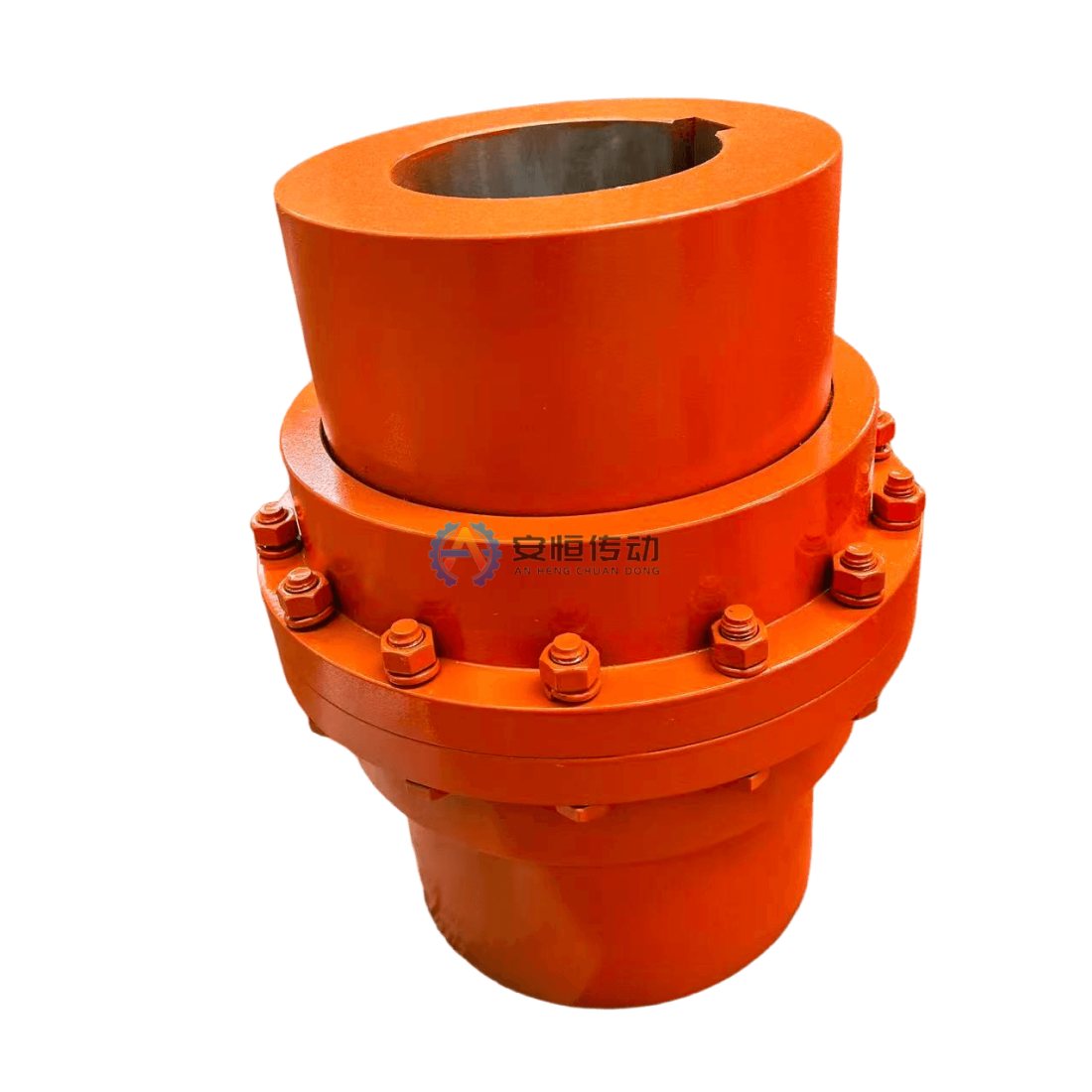
What a barrel coupling does, and why it is not a standard gear coupling
A barrel coupling transmits hoist torque from the reducer output shaft to the drum and also carries the radial load at that end of the drum, so the drum is effectively supported on the coupling and the reducer output shaft. Its crowned teeth let the drum axis tilt slightly relative to the reducer shaft and allow limited axial movement, which the drum needs as rope load and temperature change.
That is the main difference from a standard double-engagement Drum Gear Coupling: a barrel coupling is built to carry radial load and is mounted with its sleeve bolted to the drum, but as a single joint it accepts angular misalignment rather than parallel offset. Do not replace a barrel coupling with a standard gear coupling, which is not designed to carry the drum’s weight and rope load. Port duty adds frequent lifts, emergency stops that bring peak torque well above rated torque, and salt spray on every exposed surface.
How to read the barrel coupling wear indicator
Most barrel couplings carry a wear indicator: a pointer on one part and a scale or mark on the other that shows how far the hub and sleeve have rotated relative to each other as the teeth wear. Read it in the same load condition every time, as the coupling documentation specifies, because readings taken with the drum loaded and unloaded are not comparable.
Set the inspection interval from the coupling manufacturer’s instructions and the crane’s duty, and shorten it on cranes with heavy, continuous work. At each inspection, record:
- The indicator reading and the load condition it was taken in.
- Operating hours or lifts since the last reading.
- Grease condition at the last regreasing and any seal leakage.
- Bolt torque marks and the axial position against the marks on the coupling.
The trend matters more than any single reading. A steady, slow movement toward the limit lets you order parts in time, while a sudden jump between two readings points to a change such as lost lubrication, a loose bolt or misalignment, and needs investigating before the next shift.
Lubrication and seals in salt air
The teeth live on grease, and once it is lost or contaminated, wear accelerates quickly. Use the grease the coupling manufacturer specifies, typically one with good adhesion, water resistance and corrosion protection, and follow its regreasing interval, shortening it for heavy duty and wet, salty conditions.
At each regreasing, check what comes out: grease that is milky or rust-coloured means water has got in, and dry, dark grease means the interval is too long. Inspect the seals and cover joint for leaks and cracks, check that plugs and grease nipples are tight, and treat corrosion on exposed parts as a sign that the protective coating and seals need attention.
Other checks: bolts, axial movement, drum bearing and alignment
The indicator only covers tooth wear. Add these checks to the same inspection round:
- Bolts between sleeve and drum flange, and any cover bolts: check torque marks and look for fretting rust at joints.
- Axial movement: confirm the axial position is within the marks, since running at the end of travel loads the teeth and seals.
- Drum support bearing at the opposite end, and the reducer output shaft bearings, which share the drum load with the coupling.
- Alignment between reducer shaft and drum axis, especially after any work on the reducer mounting or drum bearings.
Unusual noise or knocking at hoist start, or rising vibration at the drum end, is a useful clue when combined with the indicator reading and these checks, but it does not tell you the wear on its own. Typical scenario: an indicator reading jumps after a bearing change on the drum, and the cause turns out to be alignment, not the coupling.
At the replacement limit: full set or sleeve only?
When the indicator reaches its limit, replace the coupling at the next planned stop; do not keep running a crane hoist past that mark. Replace earlier if teeth are cracked or chipped, the hub is loose on the shaft, or the sleeve-to-drum joint shows movement.
Hub and sleeve teeth wear together, so in most cases replace them as a matched set. Fitting a new sleeve to a worn hub, or the other way round, gives poor tooth contact and short life; replace one part alone only if the coupling documentation allows it and the other part checks out within limits.
Because port cranes cannot wait long, order the replacement when the trend shows the limit approaching, not when it is reached. Keep the coupling drawing, nameplate data and shaft and drum flange dimensions on file; our hoist coupling RFQ guide lists what a supplier needs.
FAQ
How often should the barrel coupling wear indicator be read?
As often as the coupling documentation and crane maintenance plan require, and more often on cranes with heavy, continuous duty. Reading it at every regreasing is a practical minimum, because the coupling is already being attended to.
Can a standard drum gear coupling replace a barrel coupling?
No. A standard drum gear coupling is not designed to carry the drum’s radial load, and its mounting and axial movement limits are different. Replace a barrel coupling with a barrel coupling built for the same load and interface.
What should we send to order a replacement?
The coupling drawing or nameplate if available, otherwise photos and measured dimensions of the reducer shaft, keyway, drum flange and bolt pattern, plus hoist motor rated power and speed, reducer ratio and drum load data. Indicator readings and photos of the worn teeth also help confirm the design.
Read the barrel coupling wear indicator the same way every time, track the trend, keep grease and seals in shape against salt air, and order the replacement before the limit arrives. We make replacement couplings from drawings or from photos and measured dimensions; standard sizes ship in as little as 10 days and copies made from an old part take from 20 days, non-standard designs are confirmed after drawing review, and a material certificate (mill test certificate), dimensional inspection report and ultrasonic testing (UT) report can be supplied with the shipment. Send us your drawing or photos and dimensions of your drum gear coupling with hoist data.
Need an engineering selection or replacement review?
Send power, speed, shaft diameters, keyway, installation dimensions, drawings or old-part photos. We will review the working condition before confirming the model and quotation.