
Technical Articles
Roller Chain Coupling Maintenance on Sinter Plant Feeders: Chain Elongation, Sprocket Wear and Grease in Dust
Roller chain couplings on the reducer outputs of sinter plant disc feeders and belt feeders run slowly, carry high torque and work in a cloud of ore and flux dust. The chain stretches, the sprocket teeth wear into hooks, and a new chain fitted to worn sprockets lasts only a fraction of the time it should. Here is how to measure and record wear, keep grease and cover working in the dust, choose between a chain alone and a chain with both sprockets, and fit the new parts correctly.
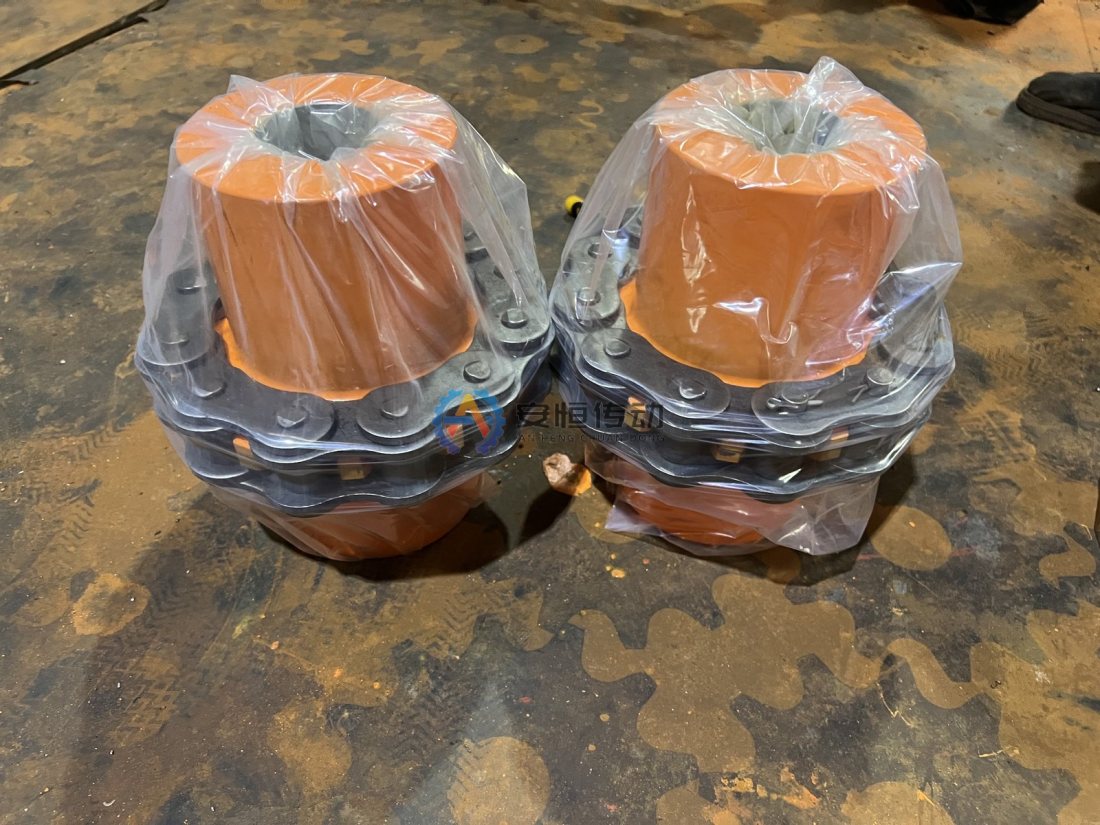
What the proportioning area does to chain couplings
A Roller Chain Coupling joins two sprockets with a double-strand roller chain, and all the torque passes through the pins and bushes of that chain. On a feeder output the speed is low and the torque high, so joint pressure is high, and every start against a full bin adds a breakaway torque well above the running torque.
Iron ore fines, limestone and burnt lime dust get into the chain joints wherever the cover or seals leak, and mixed with grease they turn into a grinding paste. Where feeders handle hot return fines, radiant heat dries the grease and ages the seals faster, so the same coupling wears at different rates along one proportioning line.
Measuring chain elongation and sprocket wear
Wear shows up first as free play, so measure it the same way at every inspection and record it per feeder. Use these checks:
- Rotational free play: hold the reducer side, rock the driven side by hand both ways and measure the movement at the chain with a dial indicator or scribed marks.
- Chain elongation: remove the chain, lay it flat, pull it straight with light tension and measure over as many pitches as practical, then compare with a new chain of the same type.
- Sprocket teeth: look for hooked teeth worn on the driving side, pointed teeth where the drive reverses, and tooth flanks that are polished or thinned.
- Rollers and side plates: cracked rollers, worn plates and stiff joints that no longer flex freely.
A new chain of the same type is the best reference for both length and free play, so keep one in stores. Photograph the sprocket teeth with a scale in the picture, because hooking develops slowly and is easier to see when you compare pictures over time.
Grease and cover: keeping the dust out
A chain coupling running without its cover in this dust will wear out quickly, however good the chain is. Check that the cover is not cracked or distorted, that its bolts are tight, and that the seals at both hubs are soft, seated and not torn; grease leaking from a seal is a clue that dust can get in the same way.
Use a grease that suits the temperature at the coupling and stays in place, and fill the amount the coupling instructions give, not more and not less. If the grease feels gritty when you open the cover, clean the chain and sprockets and refill with fresh grease rather than topping up on top of the paste.
Where radiant heat is strong, check whether the cover and seal materials suit the temperature at that position, and add a heat shield if the feeder layout allows. Noise or a warm cover can point to dry or contaminated grease, but read them together with what you find inside, not as a diagnosis on their own.
Chain only, or chain and both sprockets?
Sprockets and chain wear together, and mixing old and new parts is the main cause of short service lives. A new chain on hooked sprockets does not seat properly and wears quickly, and an old, stretched chain on new sprockets wears the new teeth in the same way. On most chain couplings the sprockets are part of the hubs, so changing a sprocket means changing the hub and checking its bore and keyway against the shaft.
| Finding | Action |
|---|---|
| Chain elongated, sprocket teeth in good shape | New chain only |
| Hooked, pointed or thinned teeth on one or both sprockets | New chain and both sprockets together |
| Cracked rollers or a broken connecting link, teeth in good shape | New chain, then look for the cause of the overload |
Typical scenario: on a disc feeder in the proportioning bay, a new chain wears out much sooner than the one before it. If the sprocket teeth turn out to be hooked and the cover seal torn, the right fix is both sprockets, a new chain and a new seal at the same stop, not another chain.
Fitting the new parts
Alignment matters even on a coupling that tolerates some misalignment, because a misaligned chain loads one strand and one side of each tooth more heavily. Check the sprockets with a straightedge across both tooth tip circles at several points around, and measure the gap between the sprocket faces at the same points, setting it as the coupling data requires.
Wrap the chain around both sprockets, insert the connecting link and secure its spring clip or cotter pins fully, then check that the chain turns freely by hand through a full revolution. Fit the cover with new seals, fill the specified amount of grease, close and tighten the cover bolts, and check for grease leaks after the first run. Related reading: Chain Coupling vs Gear Coupling for Low-Speed Cement Plant Conveyors and Coupling Guard Inspection Checklist for Heavy-Duty Equipment.
FAQ
How often should the chain be checked?
There is no fixed interval for sinter plant dust. Start with short intervals after fitting new parts, record free play and grease condition each time, and lengthen the interval once the readings change slowly and predictably; feeders that start often or sit near hot return fines need checking more often.
Can I use a single-strand chain instead of the double-strand chain?
No. The coupling is sized for the chain it was designed with, and a different chain changes the torque the joint can carry and the fit on the sprockets.
Why do the cover seals keep failing?
Common causes are heat drying out the seal material, misalignment working the seals unevenly, and abrasive dust cutting the seal lip. Check alignment and heat at that position before fitting the next seals.
Before the next stop, measure free play, photograph the sprocket teeth and note the shaft diameters, keyways and distance between shaft ends on each feeder. We make the Roller Chain Coupling in the GL and KC series, and replacement sprocket hubs in C45 (≈ AISI 1045) or 42CrMo4 (≈ AISI 4140) bored to your measured shafts; standard sizes ship in as little as 10 days and copies made from an old part take from 20 days, non-standard hubs are confirmed after drawing review, and a dimensional inspection report can be supplied with the shipment. Send us your drawing or measured data, and we will confirm whether each feeder needs a chain, sprockets or a complete coupling.
Need an engineering selection or replacement review?
Send power, speed, shaft diameters, keyway, installation dimensions, drawings or old-part photos. We will review the working condition before confirming the model and quotation.