Technical Articles
Single Roll Crusher Safety Coupling: Sourcing Replacement Shear Pins Without Losing Overload Protection
On a sinter machine’s single roll crusher, the shear pins in the safety coupling are consumables, and when they break often the temptation is to fit whatever is at hand. A standard bolt or a pin turned from bar stock keeps the crusher running, but it usually removes the protection the coupling was there for. Here is what sets a shear pin’s release torque, what to check at each pin change, how to source proper pins, and when the whole coupling should be replaced.
What the safety coupling protects on a single roll crusher
The crusher breaks hot sinter cake as it leaves the sinter machine, with a toothed roll working against grate bars, so large lumps and tramp material such as broken grate parts jam it regularly. Each jam produces a peak torque far above running torque, and without a release device that torque goes straight into the reducer, the roll shaft and the roll teeth.
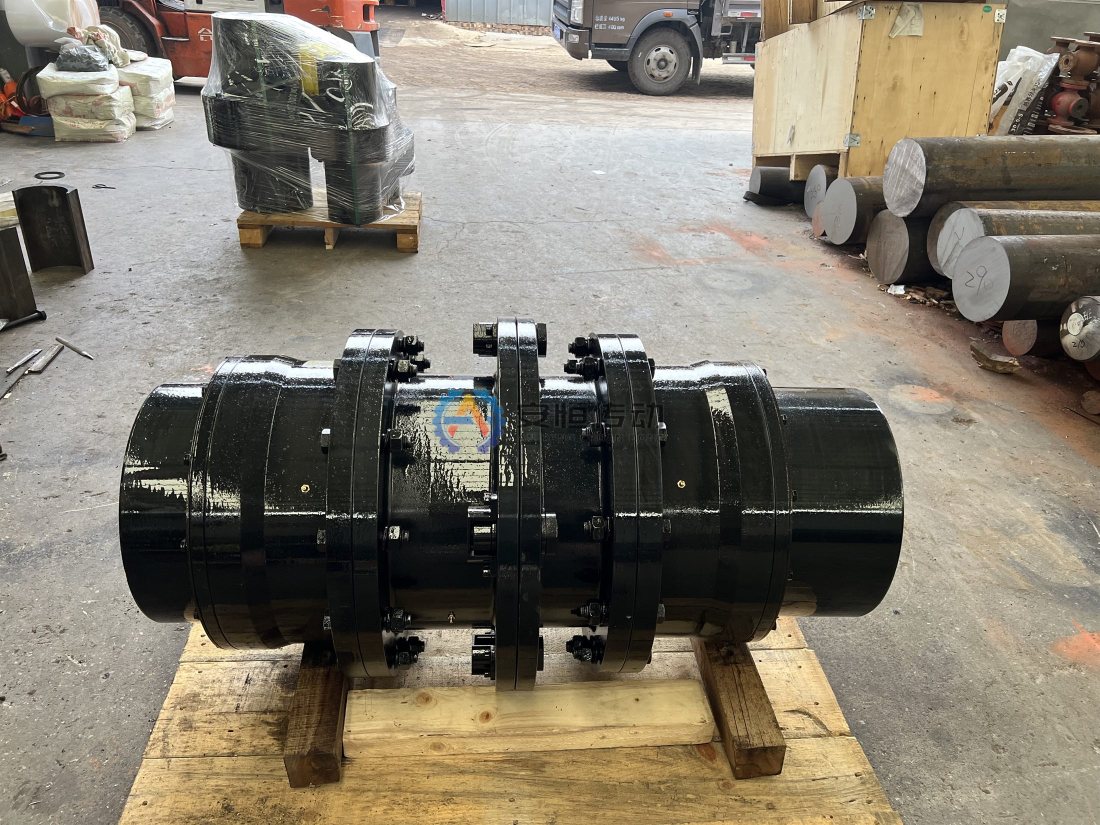
A shear pin Safety Coupling sits between reducer and roll shaft and connects its two halves through pins in hardened bushings. When torque reaches the release torque, the pins shear at the joint between the halves and the drive is disconnected; the halves then turn relative to each other until the motor stops. For how the release and reset options differ, see our article on safety coupling working principle.
Why a bolt or a home-made pin is not a shear pin
A shear pin’s release torque depends on its material and heat treatment, the diameter of its shear section, where that section sits relative to the joint between the halves, the pin pitch circle and the number of pins. Original pins usually have a groove or reduced section placed exactly at the joint, so they break cleanly at a predictable torque.
A standard bolt has none of that control. Its strength depends on a grade that may not match the original pin, the shear plane may fall on the full shank or the thread, and if it is tightened, clamping friction between the halves adds torque that the pin never had to carry. The result can be a release torque far above the original setting, or so scattered that nobody knows where it sits.
A pin that is too strong passes the overload to the reducer, the roll shaft and the teeth, which cost far more than a box of pins. A pin that is too weak breaks in normal crushing, and crews then reach for something stronger, which is how most protection gets lost. Typical scenario: after a run of nuisance breaks, standard bolts are fitted and the breaks stop, until a jam cracks a reducer gear or bends the roll shaft.
What to check every time you change pins
A pin change is the cheapest inspection you will get, because the coupling is already stopped and opened. Before fitting new pins, check the following:
- Pin holes and bushings: scoring, ovality or a loose bushing mean the new pin will rock under load and break below its set torque.
- Pin fragments: remove every piece, since a fragment left in a bushing can jam the halves or seat the new pin badly.
- Faces and bearing surfaces between the halves: galling or heat marks show how long the halves ran against each other after the last break.
- Heat damage: discoloration or distortion of the halves from radiant heat off the hot sinter, which affects bushing fit and pin alignment.
- Fasteners and alignment: loose flange bolts or misalignment add bending to the pins on every revolution.
If the halves ran together for a long time after a break, check that the motor trips quickly when the pins shear. Combine motor current trends with the break log to judge how often the crusher is really jamming; the current does not give you the pin load directly.
How to source replacement shear pins
Treat shear pins as calibrated parts, not fasteners. Give the supplier what they need to reproduce the release torque, not just the outside dimensions:
- An unused original pin if you have one, or the broken halves, or a drawing; photos with measured dimensions are the minimum.
- The original set release torque from the coupling drawing or nameplate, the number of pins and the pin pitch circle.
- Pin material and heat treatment if known, and the bushing bore and length.
Ask for each production batch to be marked, and for samples from every batch to be break-tested in a fixture that reproduces the shear plane, with the result recorded against the set release torque. Keep pins from one batch together and do not mix batches in one coupling, because pins of different strength share load unevenly and break one by one. We can make pins and couplings from drawings or from photos and measured dimensions, with material and heat treatment confirmed for the job, and supply a material certificate (mill test certificate) and heat treatment report.
When to replace the whole safety coupling
New pins only make sense if the coupling around them is sound and the setting still fits the duty. Replace the coupling, or at least rework it, when you see any of these signs:
- Bushings or pin holes worn beyond the limit on the drawing, or holes too oval to take new bushings.
- Release frequency that is abnormal: breaks far more often than before with no change in feed, or no break during a jam that clearly should have released.
- A set release torque that no longer matches the duty, for example after a motor, reducer or throughput change.
- Distortion of the halves from heat, or galled bearing surfaces from long running after breaks.
The release torque should sit above the peak torque of normal crushing but below what the reducer, roll shaft and teeth can take; our article on coupling torque rating vs peak torque covers how to set that margin. If jams are frequent and every break costs a pin change, consider whether a resettable design suits the crusher better; before we pick a size for a new safety coupling, we check torque, speed, shaft diameter, keyway, service factor, misalignment and the working environment.
FAQ
Can our workshop make shear pins?
Only if it can match the original material, heat treatment and shear section exactly, and break-test samples to confirm the release torque. Without the test, a home-made pin is a guess, and a guess on the strong side puts the reducer at risk.
Why do new pins break below the set torque?
Usually because of worn bushings or oval holes that let the pin rock, misalignment that adds bending, fatigue from long running near the limit, or a weak batch. Check the coupling first, then the batch test record.
Should we raise the release torque to stop nuisance breaks?
Only after checking that the reducer, roll shaft and teeth can take the higher setting and that the breaks are not caused by worn bushings or bad pins. Raising the setting without that check is the same mistake as fitting a bolt, just on paper.
If your crusher is going through shear pins, inspect the coupling at the next pin change, find out why it jams, and source pins that reproduce the original release torque rather than just the original size. Standard sizes ship in as little as 10 days and copies made from an old part take from 20 days, and for non-standard parts we confirm it after reviewing the drawing. Send us your drawing, or photos of the old pin and coupling with measured dimensions and the set release torque, and we will quote pins or a complete coupling.
Need an engineering selection or replacement review?
Send power, speed, shaft diameters, keyway, installation dimensions, drawings or old-part photos. We will review the working condition before confirming the model and quotation.